Work Environment Survey - for managers - Kunnskapsbasen
Work Environment Survey - for managers
The website is being updated. If possible, use the Norwegian original which is more extensive and updated.
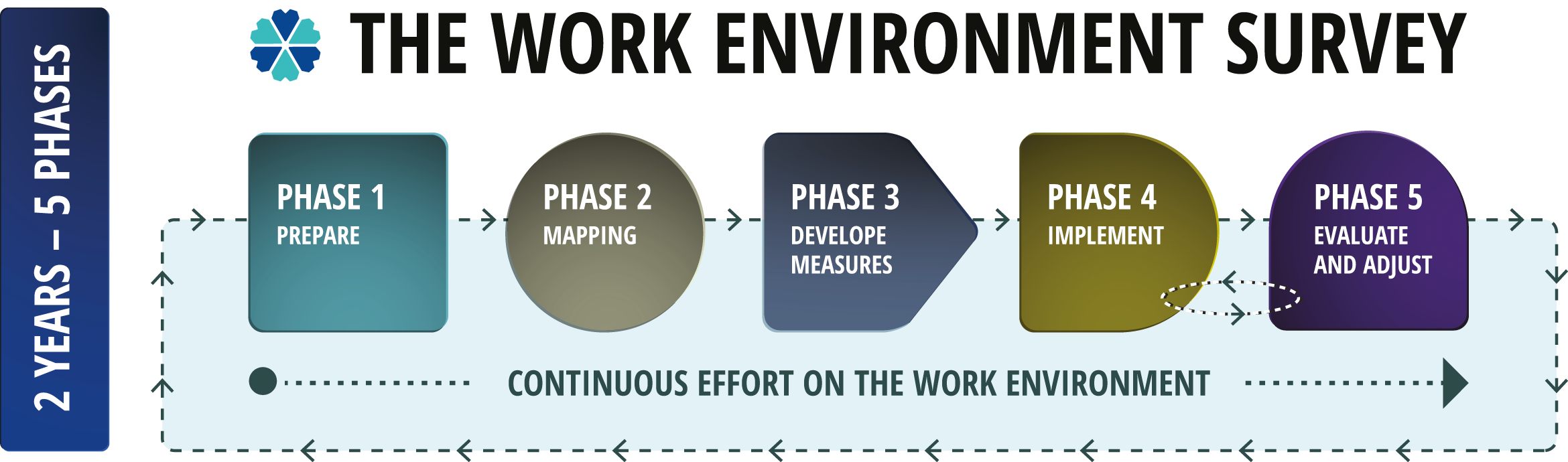
The Work Environment Survey is one of the tools you have at your disposal to develop a positive working environment. As a manager, you are responsible for surveying the unit you lead. The survey is conducted every two years, with subsequent development of measures, implementation of measures, and follow-up of the action plan.
Contact your local coordinator for the Work Environment Survey if you need any assistance in this work. See the list of coordinators at the bottom of his webpage.
Norwegian version: Arbeidsmiljøundersøkelse – for ledere
Work Environment Survey – for employees | HSE topics page | Psychosocial work environment
Innholdsfortegnelse [-]
- Why is NTNU conducting a work environment survey?
- ARK Academy offers advice and tools for managers in each ARK phase
- Work Environment Efforts 2023-2024
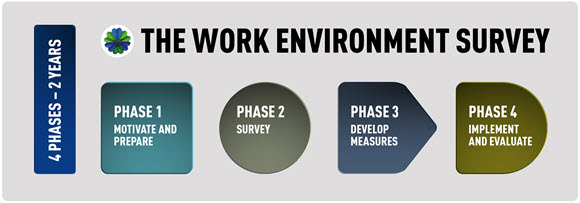
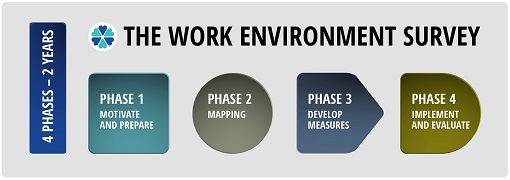
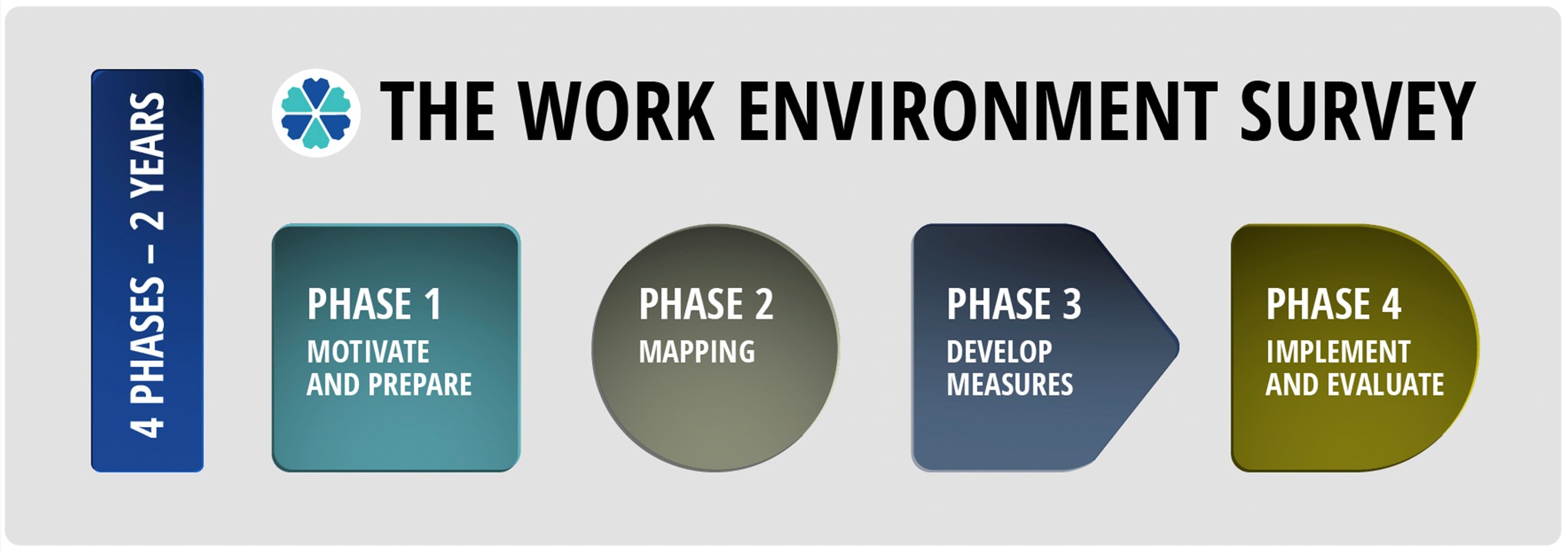
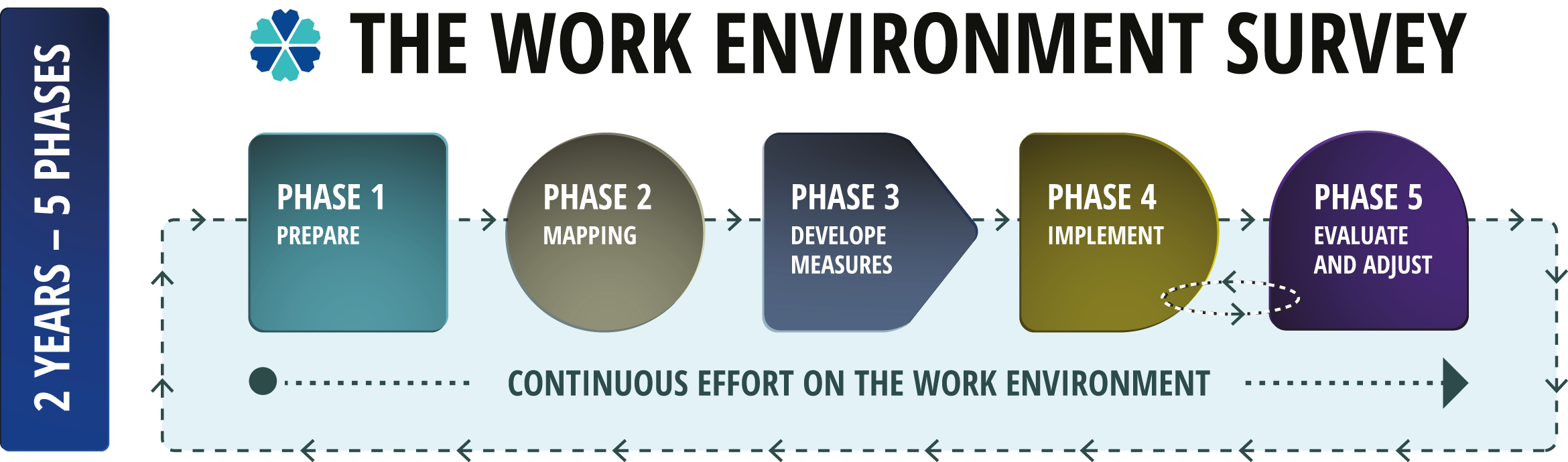
- Phase 1 – Motivate and prepare
- Phase 2 - Survey
- Phase 3 – Develop Measures
- Phase 4 – Implement
- Phase 5 – Implement and adjust
- Results from previous surveys
- Role of Safety Representatives
- Available help
- Contacts
Why is NTNU conducting a work environment survey?
- A sound, well-functioning work environment is essential to achieving NTNU's goals.
- To learn more about how staff perceive their working conditions.
- To provide a basis for strategic work environment initiatives and organizational development measures.
- To help ensure that all NTNU staff have a safe work environment.
As a manager, you are expected to:
- Set goals for the work environment work at your unit.
- Encourage all employees at your unit to respond to the survey and participate in the follow-up work.
- Conduct a follow-up meeting at your unit before 1 May 2024.
- Develop an action plan.
- Implement, evaluate, and adjust the action plan.
- Involve safety representatives and LOSAM throughout the process.
- Dialogue in your line of management about the follow-up process in 2024-2025, evaluation, and adjustment of measures and action plans. measures.
The work environment survey is mapping the work climate in the unit and at NTNU as a whole. It gives the employees an opportunity to voice how they feel at work. This feedback helps you as a leader in your work to promote a positive work environment in agreement with NTNU's values - creative, critical, constructive, and respectful, with the aim to realize NTNU's goals.
See the schedule of work for leaders in pdf format, which you may print out (PowerPoint in Norwegian). See also the Memo from the Director for Organization and Infrastructure about the Work Environment Survey 2023-2025.
The main survey themes are:
- Organizational conditions at your unit
- Unwanted incidents and corrective measures
- Opportunities for learning and development
- Management at the unit
- You and your colleagues
- You and your work
- Your daily job
More about the work environment and work climate survey on the ARK website.
ARK Academy offers advice and tools for managers in each ARK phase
This year ARK has developed a platform for professional advice and practical tools for managers in each phase of the ARK process. The ARK Academy Platform will in the future replace much of the information on this webpage (in Norwegian only). Login with Feide. If you are unable to do so, contact your ARK coordinator to be added to the user group.
Work Environment Efforts 2023-2024
Phase 1 – Motivate and prepare
Phase 1: Motivate and prepare – August-October 2023:
1. Put the Work Environment Survey on the agenda at a management meeting (level 2) with the Local Coordinators for the Work Environment Survey. Deadline: September 2023.
2. Fill out the form ‘Preparation for the Work Environment Survey’ in collaboration with the safety representative. The completed form should be archived in ePhorte in the unit dossier by 13 October 2023. NB! A dossier will be created for each unit for easy access to the survey results on a form similar to this example: Arbeidsmiljøundersøkelse 2023 MH ISM* (tip: use advanced search in ephorte and * to see all underlying units you have access to). This link provides a list of the unit abbreviations that DOKU has used in 2023 (unit abbreviations that were used in the 2021 survey).
3. Decide at which organizational level you wish to organize the survey (such as subject group or department level), where the employees answer, and where the manager takes responsibility for the follow-up process. Submit the updated list of survey units to the local coordinator at your Faculty. Mark which reports you need in English. Deadline: 15 September 2023.
- NTNU recommends a minimum of at least 8 employees at each response unit. At least 5 employees must respond to get a report of the results.
- Large departments/administrative divisions are recommended to select groups/sections as response units. At the departments, it is alternatively possible to run follow-up processes based on occupational category (academic recruitment positions, other academic positions, academic support staff such as laboratory engineers, and technical-administrative staff) as you will receive such reports if the number of respondents is sufficient. The departments will automatically receive the reports in both Norwegian and English.
4. Quality check of the survey distribution list end of September - the beginning of October. The local coordinator will contact the unit to ensure that the list of employees who are to receive the survey in each survey unit, is correct. Note that it is likely to be errors or staff missing on the distribution lists, particularly at the group level.
4. Inform all employees at your unit of the upcoming work environment process (for example at a general meeting). Deadline: October 2023
Phase 2 - Survey
Phase 2: Survey – November 2023 - April 2024
1. The survey will be distributed by e-mail to all employees on 6 November with a response deadline of 27 November 2023.
2. As a supplement to the survey, a qualitative mapping will take place in Phase 3 at the follow-up meeting.
Follow this link for more detailed information about the survey and the result reports, including:
- Who is participating
- Distribution of the survey
- Anonymity and use of the results
- Reports from the survey
Reports for each response unit will be made available to managers in January and should be shared with unit staff at the follow-up meeting. The reports will have the same format as the NTNU-level report (available in January 2024). The results of the response unit will provide a comparison with the results of the superior organizational level and with topics covered in the 2021 survey of the response unit.
Phase 3 – Develop Measures
Phase 3: Develop measures – February - April 2024
1) Hold planning meetings with safety representatives. See the planning meeting template (Norwegian).
- Develop a timetable for the follow-up meeting. See the template for a standard follow-up meeting (Norwegian)
- For larger groups, the world café method is suitable. See description of a follow-up meeting using the world café method (Norwegian)
- Tools for preparation: How to read the report from the ARK-survey , Themes and questions - ARK questionnaire (The questions in Norwegian)
2) Hold a follow-up meeting with all employees at your unit before Easter. Key unit personnel may assist in planning the meeting. In the meeting, you will:
- Inform staff of the process to use if they experience or have experienced unacceptable conduct, and direct them to the web page: Unacceptable behaviour – harassment and conflict
- Review and discuss the unit's results from the survey questionnaire.
- Identify the areas of strength and those needing improvement. (template for individual reflection)
- Develop an action plan with goals and measures. PPT template for the action plan (Norwegian and English)
3) The action plan will be discussed at the faculty/administrative division level. Consider whether any shared assistance or measures are needed for further action plan follow-up.
Phase 4 – Implement
Phase 4: Implement and Evaluate – May 2024 - May 2025
As a unit leader, you are responsible for following up and ensuring that the measures in the action plan are implemented in collaboration with the safety representative and employees.
The follow-up meetings and the initial process is to be assessed in an evaluation meeting with the safety representative, while the action plan is to be constantly evaluated. Consider if the measures still meet the needs of the work environment and if there is a need for other or more measures. Make adjustments to the action plan as needed in consultation with the safety representative and employees. The follow-up of the Work Environment Survey will also be on the agenda at dialogue meetings and in HSE annual reports.
1. May 2024: Conduct an evaluation meeting with the safety representative about the process thus far. Fill out together and submit the evaluation form from ARK. You will receive a link to the online form from ark-kontakt@ntnu.no. The evaluation form May 2024 (pdf to come) will be open from 6 - 24 May 2024. The form serves as documentation of the first part of the process, and the units should archive the form for later reference.
2. Implement measures throughout the period and adjust the action plans along the way as needed.
3. September 2024: Tertiary report in the NTNU management system (PBO), including questions about the follow-up of the Work Environment Survey and action plans. Assignment to all level 2 units from the Division of Governance and Management Systems (Virksomhetsstyring).
4. November 2024: Annual HSE report from all level 3 managers. The HSE report will include questions about the collaboration with the safety representative and the follow-up of the Work Environment Survey.
Phase 5 – Implement and adjust
Phase 5: Implement and adjust May 2024 - June 2025
Evaluation and learning are important. Toward the end of the two-year process, the whole process and the effect of the measures are to be evaluated. The aim is to transfer learning lessons to the conduct of the next Work Environment Survey starting in the autumn of 2025.
Conduct the final evaluation meeting with the safety representative in May 2025. Fill out together and submit the evaluation form from ARK. You will receive a link to the online form from ark-kontakt@ntnu.no. The evaluation from May 2025 (pdf to come) will serve as documentation of the whole work environment process from 2023-2025.
Results from previous surveys
- NTNU results 2023 (pdf) (in English)
- NTNU results 2021 (PDF) (in Norwegian only)
- NTNU results 2019 (PDF) (in Norwegian only)
- NTNU results 2017 (PDF) (in Norwegian only)
- NTNU results 2014 (PDF) (in Norwegian only)
- NTNU results 2012 (PDF) (in Norwegian only)
Role of Safety Representatives
As a leader, you must involve the safety representative in all phases of the work environment improvement. The minimum meeting points are:
- Preparation of the Work Environment Survey 2023 (September/October 2023)
- Planning the follow-up meeting (January 2024)
- Evaluation of the follow-up meeting and action plan (May 2024)
- Evaluation of measures and the whole process (May 2025)
At units with multiple safety representatives, the safety representatives themselves should decide who will represent them. Where several units share one safety representative, the safety representative and the deputy safety representative should divide the units between them.
The safety representative’s tasks | Contact your safety representative
Available help
- Occupational Health Services – offering independent assistance to management and employees.
- HR and HSE section – cultivating organizational and psychosocial work environment.
- Whistleblowing: Guidelines for reporting problematic conditions at NTNU
- Guidebook: The ARK-survey - health promotion in academic institutions
Contacts
Management:
- HR and HSE Director Arne Kr. Hestnes
- HSE Section Head Rasmus Hugdahl
Coordination:
- Nathalie Gaulin Brovold, HSE section (organization and communication)
- Kristin Wergeland Brekke, HR NTNU section (organization)
Resource people
Local Coordinators for the Work Environment Survey:
- AD: Erik Lunde | Marion Sandnes Wohlen
- HF: Christen Torvik
- IE: Oddrun Husby | Cathrine Haugan Grønvik
- IV: Roar Eriksen | Kristine Rognlid Hagaseth
- MH: Hanne Mattson
- NV: Nina Sandberg | Anne Marie Wingan | (Julie Elisa Wang)
- SU: Kirsten Sjolte | Ina Grønbech Halvorsen
- EAC: Svein Olav Antonsen | Randi Holvik
- University Museum: Anne Karin Henning | Aaste Line Margrethe Strand
- FA: Trine Dahl | Kristine Frøset
- FA – Property division: Marianne Schjølberg | Cecilie Holen
- Gjøvik: Lise Konow Linnerud (Building Management)
- Ålesund: Harald Jan Skarstein (Building Management)
Coordinators for the Work Environment Survey have a shared network: "Network for the Work Environment Survey at NTNU". See the network mandate here (norwegian).